Kenya is a place of incredible coffee potential, but also one shaped by a complicated history of colonialism, policy decisions, and concentrated power within the coffee trade. Despite producing some of the most recognizable and valuable coffees in the world, many Kenyan farmers have historically received only a small portion of the value their coffees eventually create. The system can also make it difficult for farmers to receive meaningful feedback about quality, understand where their coffee ultimately goes, or build direct relationships with the buyers paying premiums for it.
For us, standing in solidarity with coffee producers means building supply chains that return more value, information, and opportunity to the people doing the work of farming coffee. In Kenya, we partner with Peter Mbature, a coffee farmer, exporter, and longtime friend, to identify exceptional coffees while creating more direct relationships with the farmers producing them. Peter’s family farm, Kamavindi, and the exporting company that has grown from it represent a multigenerational effort to build a coffee trade that is more transparent, more relational, and ultimately more equitable.
At the center of that vision is a pretty simple idea: farmers deserve fair compensation, useful feedback, access to knowledge, and direct relationships with the people buying their coffee. This year, we traveled to Kenya to cup alongside Peter and the Kamavindi team, selecting coffees from farmers, estates, washing stations, and cooperatives they have built relationships with over many years. Throughout 2026, we’ll be releasing a small handful of coffees that we think reflect both the remarkable quality Kenya is capable of producing and the kind of coffee trade we want to support.
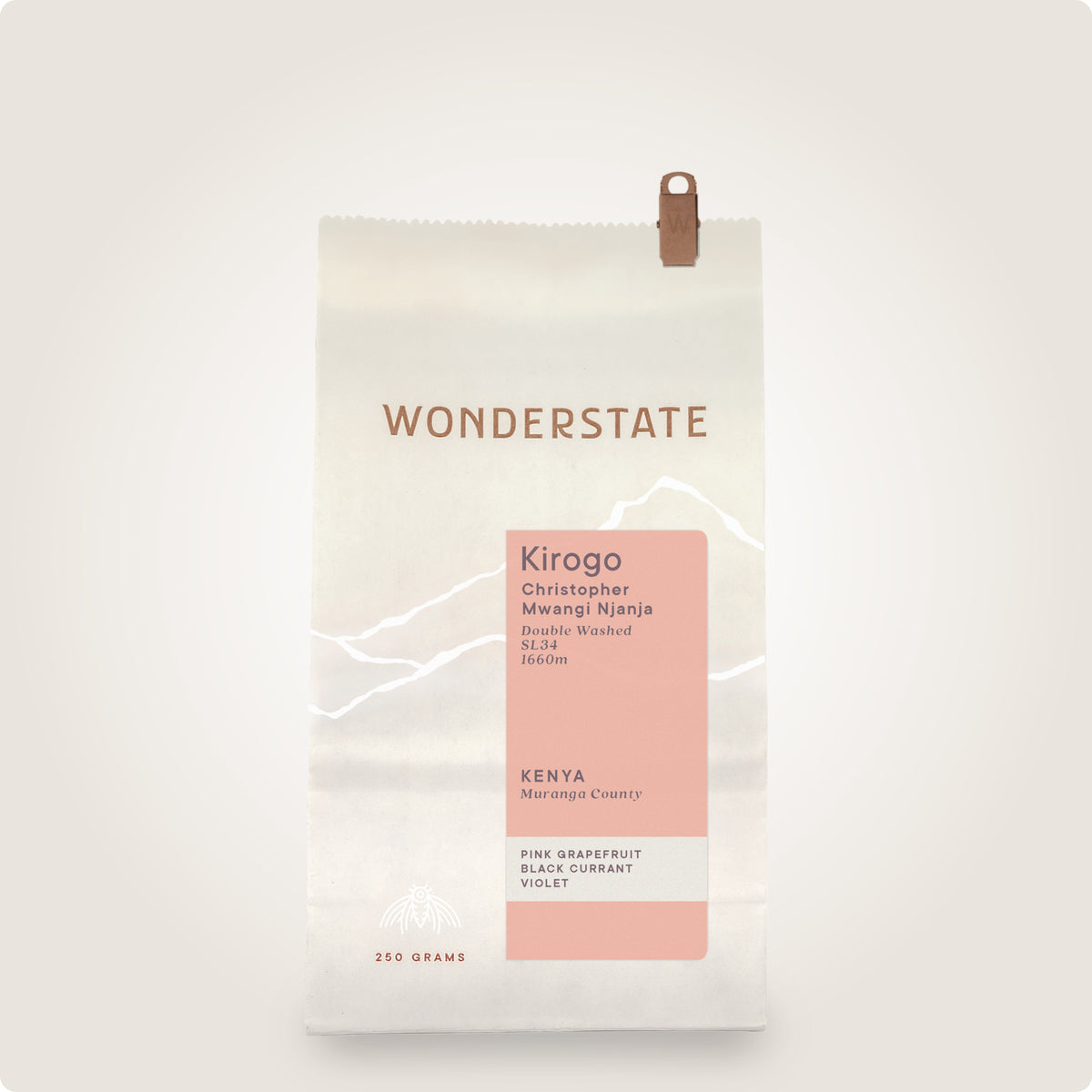
Kirogo may be the clearest example.
Christopher Mwangi Njanja is a coffee quality expert who works with New KPCU, an organization that provides Kenyan farmers and cooperatives with services including milling, financing, quality evaluation, and access to coffee markets. Through that work, Chris has tasted thousands of coffees from across the country and developed a deep understanding of the profiles produced throughout Kenya.
In 2019, Chris was cupping through a table of “mbuni,” coffees in Kenya that have traditionally been associated with lower-value and lower-quality. One cup stopped him completely. Instead of the rough or muted profile he expected, the coffee was vibrant, sweet, complex, and obviously special. Chris traced it back to a small estate called Kirogo in Murang’a and decided he needed to see the farm for himself.
There, he met Jonathan Muturi, who had farmed coffee for much of his life. The estate was in rough shape. Vegetation had overtaken much of the property, the coffee trees had grown heavily and were unmanageable, and the farm was producing very little coffee. But as Chris walked the property, he realized something unusual: nearly the entire farm was planted with SL34.
SL34 is one of the varieties most closely associated with the classic Kenyan coffee profile, but farms planted almost entirely with it have become increasingly uncommon as older fields have been renovated and newer varieties introduced. Chris saw something worth saving. Working alongside Jonathan, he began restoring the farm, improving tree health, refining agricultural practices, and focusing more carefully on harvesting and processing. Year by year, the coffee got better.
Jonathan recently passed away, but his family has chosen to continue working with Chris and keep the project moving forward. Production remains tiny. This year, Chris was able to produce only about 300 kilos of exportable coffee, but the quality was undeniable. When we tasted Kirogo during our visit to Kenya, it had everything we love about the country’s best coffees: bright citric acidity, deep savory fruit, and a delicate floral quality that gave the cup surprising elegance.
What began as one unexpected cup on a table of mbuni coffee has become a years-long effort to restore an overlooked farm and uncover the quality that was there all along.