


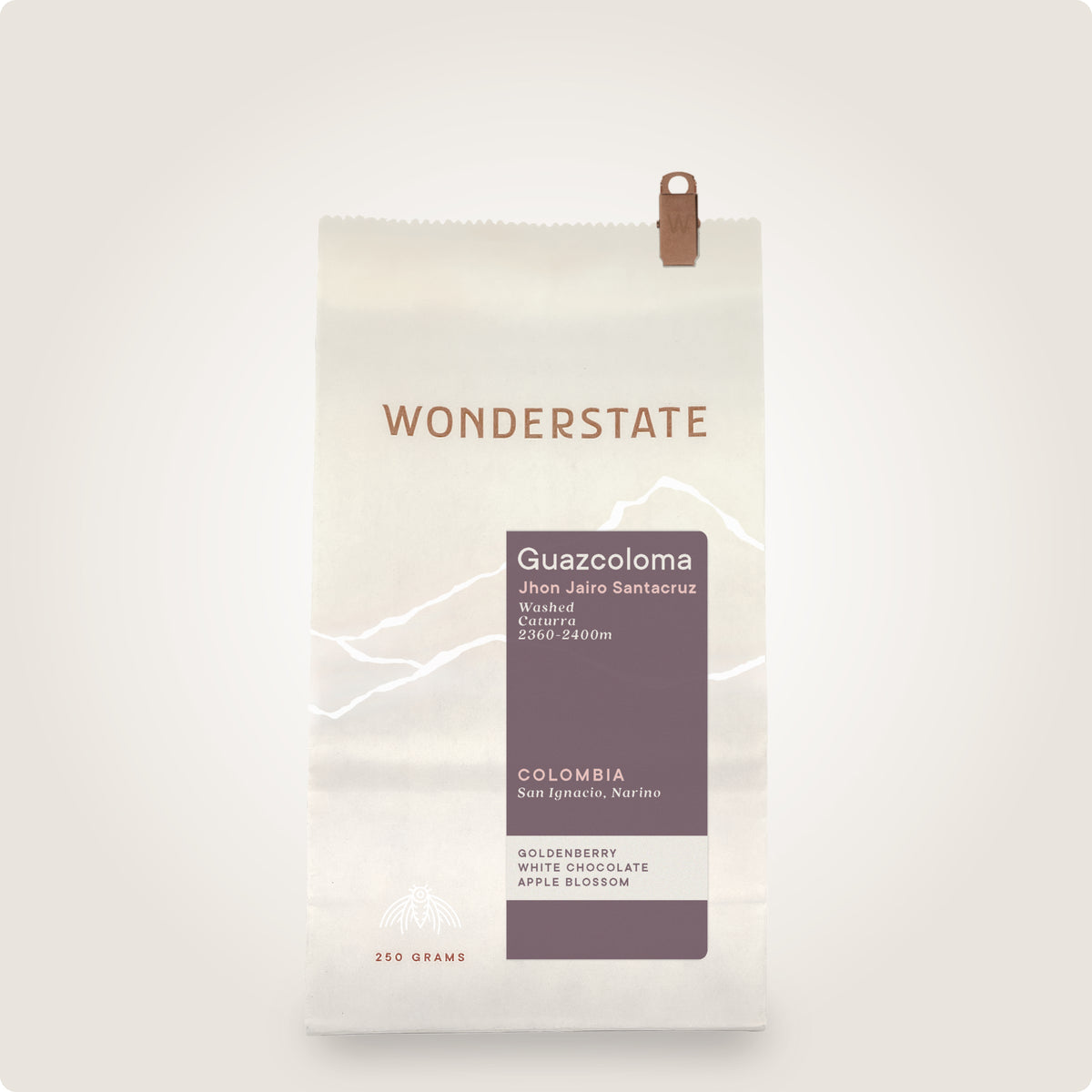

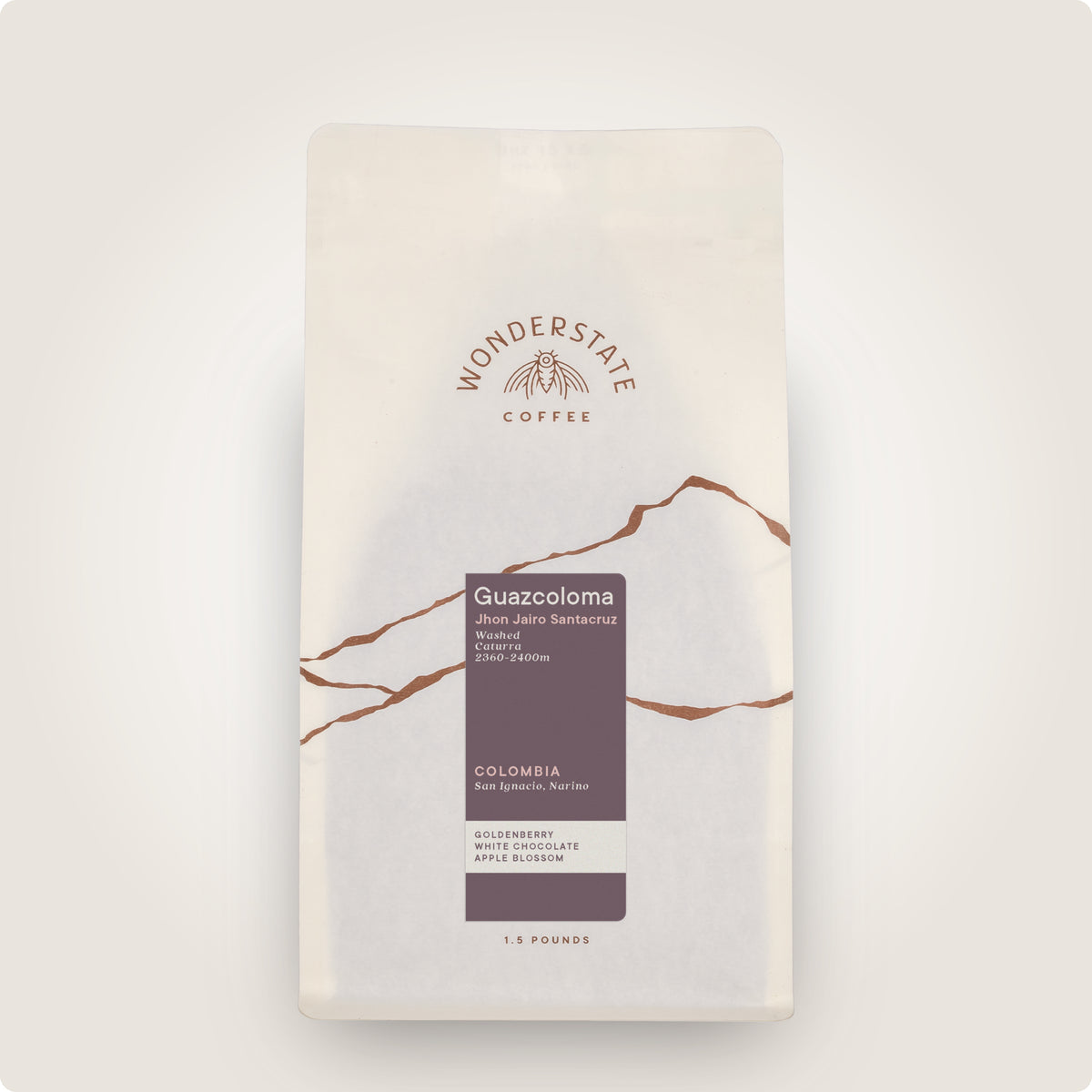
Colombia Guazcoloma
Process: Washed
Notes of Goldenberry, White Chocolate & Apple Blossom
A structured, balanced, and transparent profile with savory-fruitness of goldenberry, decadant white chocolate, and a herbal-floral lift of apple blossom
Available in whole bean only.
Specs
Altitude: 2360-2400 meters
Varietals: Caturra
Process:
Cherries are sorted and depulped, feremented for 24-72 hours before washing and drying on raised beds in shaded conditions
Harvest: July - September 2025
Region: San Ignacio, Narino
About the Coffee
Colombia is a country of short distances and extreme variation, where one ridge catches late afternoon sun and warm air rising from a river valley while the next turns cold by midafternoon and holds mist until morning, and where communities only miles apart produce coffees that taste as if they come from entirely different worlds. It is a landscape that resists simplification and refuses to sit comfortably inside binary categories.
For decades, the Colombian state attempted to stabilize that complexity. Through the Federación Nacional de Cafeteros and Cenicafé, it built one of the most ambitious coffee infrastructures in the world, sending extension agents into remote communities, distributing government approved seedlings, and encouraging farmers to replace older heirloom varieties with new hybrids designed for productivity and disease resistance. The priorities were stability, export volume, and resilience. Farmers, however, needed trees that would survive, produce well, and still cup beautifully, and they needed a market that recognized the labor behind that quality.
When Coffee Leaf Rust threatened the Americas in the late 1970s and early 1980s, Colombia reshaped its genetic landscape at scale. Traditional arabica varieties such as Typica, Bourbon, and Caturra gradually gave way to state distributed hybrids, with Variedad Colombia becoming emblematic of that shift. These varieties brought resistance and higher yields, but they also altered the sensory identity of Colombian coffee, moving many farms away from the classic sweetness and aromatic complexity of older arabicas toward profiles that felt different and at times flatter or more bitter. Today, Bourbon and Caturra remain in smaller volumes, early hybrids persist on aging small farms, Castillo spread widely after renewed rust pressure in the early 2010s, and in some communities Gesha and Pink Bourbon now grow beside mature hybrid blocks, all responding to the same shifting climate.
Nariño continues to be the unsung song of Colombian coffee. While much of the industry has chased the variety craze north to Huila and Antioquia, Nariño remains overlooked and at times outright forgotten, and the people here feel it in ways that are subtle but unmistakable. There is a quiet defiance that runs through the region, a sense of being peripheral to the center of power, of existing at the margins of a country that often looks elsewhere for its headlines and its praise. The culture carries a distinctly Andean tone that feels more Cusco than Bogotá, more highland Perú than mainstream Colombia, and the mountains alone could be mistaken for Amaybamba, jagged and impossibly high, while ranges just a hundred miles away feel like another world entirely.
The mountains that cut through Nariño are dramatic and relentless, shaping not only the landscape but the people who have chosen to remain here. Coffee is grown at elevations we have otherwise only encountered in Ethiopia and Peru, on farms that average two to five acres, carved into steep hillsides that demand physical endurance and long memories. In this terrain, coffee cultivation is not a lifestyle accessory or a speculative investment but a practice of resilience and dedication that resists being boxed into a single narrative about innovation or hype. The altitude sharpens acidity, slows maturation, and rewards patience, but it also exposes the fragility of smallholder economics in a region that has historically been left to fend for itself.
Unlike departments such as Huila and Antioquia that have recently benefited from major influxes of new varieties and renewed attention, Nariño’s genetic landscape has largely been shaped by history rather than innovation. For years, many parts of Nariño were not safe. Paramilitary groups and armed actors displaced countless families, and entire communities were forced from their land. It was not until the mid 2010s, following the peace accords between the FARC and the Colombian government, that many families began returning to reclaim their farms and rebuild what had been fractured. The varieties they planted were often simply what was available through government programs at the time, different iterations of Variedad Colombia and Castillo, practical and resilient selections rather than fashionable ones, and like so many farmers across the country they made do with what they had, learning how to coax clarity and beauty from cultivars that were never meant to headline a menu.
Nariño has always existed at the edge, geographically, politically, and economically, and yet some of the most precise, transparent, and emotionally resonant coffees in Colombia are grown here, often without recognition and far too often without proper value. It is within this context that Wonderstate has committed to working with a small group of farmers who are producing extraordinary coffees that might otherwise be overlooked, forgotten, or undervalued by a market that tends to follow noise more than nuance.
A few years ago, Wonderstate began purchasing coffee from Toldopamba, a family farm with deep roots in Nariño and a modest exporting company that measures success less in margins and more in mutual trust, placing people before profit and relationship over trend. This year we spent nearly a week in the mountains with Carlos Torres Burbano and Angela Patiño Findlay, the husband and wife team who have shaped Finca Toldopamba into a remarkable farm and, just as importantly, cultivated a network of deeply committed growers whose coffees express the sharp altitude, quiet intensity, and enduring resilience that define Nariño at its best. Angela is a Q Grader and one of the most perceptive and disciplined tasters we know, someone whose palate carries both precision and conviction, and Carlos is a true systems thinker, a quiet architect of technology and logistics who understands that quality is not accidental but engineered through structure, repetition, and care. Together they have built a company that refuses the false tradeoff between transparency and quality, proving that rigorous systems and relational trust are not opposing forces but mutually reinforcing commitments that shape every lot that leaves their mountains.
About the Producer
One of the many highlights of visiting Nariño was finally meeting Jhon Santacruz, whose coffee we have released previously and enjoyed for years. Jhon’s farm, Guazcaloma, a compound word with Indigenous Andean roots likely meaning Vine Covered Hill, sits at staggering elevations ranging from 2360 meters to nearly 2400 at its peak. The farm rests along the crest of a series of hills, each rising higher than the last, and from its upper plots the entire valley of the San Ignacio community unfolds in a way that remains one of the most beautiful scenes in all of our coffee travels. On this modest three acre farm, Jhon cultivates primarily Caturra, a variety we encounter less and less frequently despite its historic role in shaping Colombian coffee.
Before turning fully to coffee, Jhon’s family primarily cultivated beans and peas, crops that required steady labor with uncertain returns. Like many farmers in the region, they saw in coffee the promise of more consistent yields and a more sustainable rhythm of work. His parents maintained a small plot of coffee for home consumption, but it was Jhon who chose to expand production and pursue coffee commercially, gradually reshaping the farm’s identity. Today the family focuses primarily on coffee while also raising cattle on a small scale, balancing tradition and adaptation on land that has quietly supported them for generations.
During harvest, Jhon employs roughly twenty people who hand pick each cherry at peak ripeness, a scale of labor that feels remarkable on a three acre farm perched above 2300 meters. After picking, the coffee is carefully sorted, depulped, and fermented dry for twenty four to thirty hours without water before being washed clean and moved to raised beds inside a parabolic dryer. Drying is the most difficult part of his work. The climate at Guazcaloma is intensely cold, especially in the evenings when temperatures drop quickly and moisture lingers, and it can take more than thirty days for a single lot to reach stable moisture. Mold is a constant concern at this altitude, so Jhon has invested in improving airflow through the structure, managing layers carefully and turning the coffee with patience to ensure a slow, even, and uncompromised drying process.
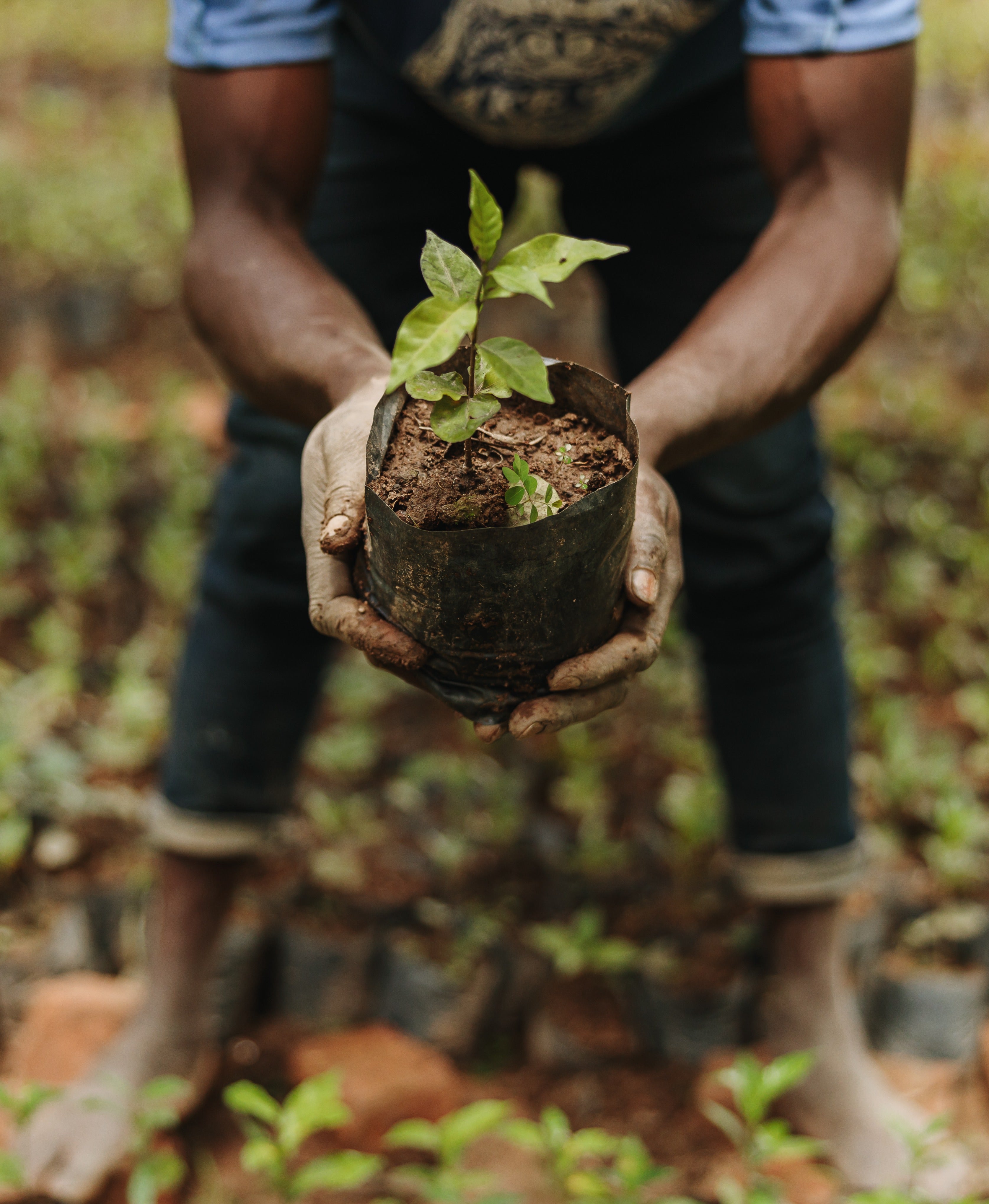
During our visit, Jhon shared that he has recently acquired Pink Bourbon seeds and is establishing a small plot of this newer variety near the original farm. While the prospect of Pink Bourbon is naturally exciting, this Caturra lot feels especially meaningful because it carries the weight of family history in its older rootstock. The cup is rustic and quietly charming, less immediately radiant than some modern selections yet deeply expressive in its own register, offering a profile that feels like an echo of Colombia before widespread hybridization and thermal shock processing. It tastes like coffee might have tasted fifty years ago, resonant and balanced, steady rather than flashy, and resolute in a way that feels entirely aligned with the land it comes from.
Why We Love It
Jhon Santacruz’s Caturra captures a taste of historic Nariño expressed in the present. Grown at strikingly high elevations on the hillsides of Guazcaloma, this selection carries the legacy of a region whose coffee story continues to evolve. In the cup, we find a structured and balanced profile built around savory-sweet goldenberry, layered with the decadent sweetness of white chocolate and lifted by a delicate apple blossom finish. It is a resonant and complete coffee, one that speaks to deep roots, cold mountains, and the enduring clarity that defines the high altitude terroir of Nariño.
