


Coffee's Next Generation
By Nick Breheny, Director of Coffee
Throughout the world, farmers are aging, and younger generations are increasingly stepping away from agriculture altogether. This isn't only happening in large-scale commodity farming in the United States. It's deeply felt across coffee-producing regions as well.
According to the World Economic Forum, the average age of farmers globally now exceeds 55 years old. Farming of any kind is physically demanding, emotionally exhausting, and often financially unstable. Without meaningful change, we risk a future where fewer and fewer people are willing to cultivate the land.
There are countless reasons young people leave coffee farming behind, but two realities surface again and again in nearly every conversation: labor and income.
Coffee has remained remarkably inexpensive for a very long time. Most of us remember when a cup of coffee cost a dollar, maybe less. What we rarely considered was that behind that cup existed a person, a family, and often an entire community whose livelihoods depended on coffee remaining economically viable.
For decades, the global price of coffee remained shockingly low. In many years, farmers received prices that failed to cover even the cost of production. It's common to speak with coffee producers operating at a loss, or surviving on margins so thin that a single bad harvest or unexpected expense can destabilize everything. The commodity price of coffee has rarely reflected the true cost of producing it: fertilizer, labor, transportation, fuel, infrastructure, equipment, processing, and the countless other expenses required simply to keep a farm operational.
 Producers of San Fernando Cooperative in Peru talk with coop leaders.
Producing coffee becomes more expensive every year while stability remains elusive. And then there's the labor itself.
Having stood on coffee farms throughout Latin America and Africa, we're continually struck by the sheer amount of physical work required to produce coffee. Farmers spend much of their lives outdoors navigating heat, rain, wind, weeds, pests, disease, mud, and increasingly unpredictable weather patterns, all while relying on crops vulnerable to forces entirely outside their control.
The work doesn't stop once the coffee is harvested. After picking and processing, the coffee still has to be transported to town. In Chiapas, many of the farmers contributing to our Santuario blend still transport coffee by horse or mule. It's a two-hour journey into town and another two hours back, often repeated several times each week throughout harvest season.
Nearly every stage depends on human labor: hand-picking cherries, sorting defects, carrying heavy sacks of fruit and parchment across steep terrain, and carefully monitoring fermentation and drying.
Younger generations see this reality clearly, and increasingly, many are deciding they don't want this life.
Older farmers are deeply aware that young people are leaving coffee behind. They're seeking opportunity, dignity, and stability. For many young people growing up around coffee farming, the work no longer appears capable of providing a viable future.
Most cooperatives and associations still lack robust programs designed to engage younger generations. Without meaningful pathways forward, many young people face the same barriers their parents encountered. Occasionally NGOs or outside organizations fund youth initiatives, but beyond that, much of the burden still falls on young farmers themselves to navigate a rapidly changing global coffee economy.
At the same time, signs of change are beginning to emerge.
Youth Unlocks Potential
Peter Mbature of Kamavindi in Kenya has observed that younger generations are often more willing to experiment. More open to new ideas. More willing to challenge inherited systems and take risks in pursuit of something better. Across coffee-producing regions, we're beginning to see that dynamic unfold in real time.
Younger producers understand global trends, specialty coffee markets, brewing culture, processing methods, social media, branding, and consumer behavior in ways previous generations never had access to. They're paying attention to what buyers value and what consumers respond to, and they're using that information to reshape how they farm. For some, that shift changes everything.
Three Young Farmers Forging the Path Forward
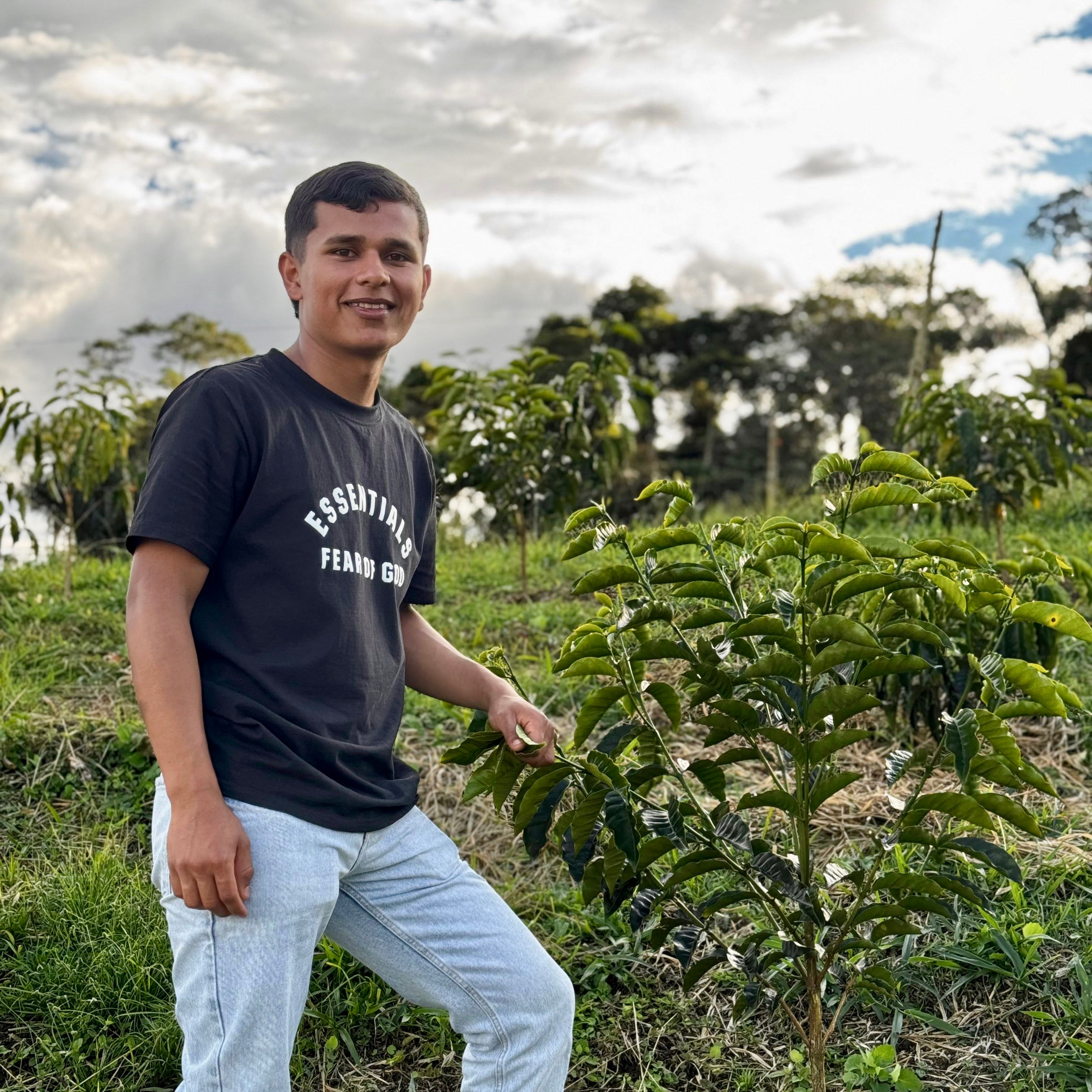
 Marlon Bolaños, Acevedo, Huila, Colombia
Marlon grew up surrounded by coffee, but like many young people raised in coffee-farming families, he didn't initially see a future in it. Huila has long held a reputation for producing exceptional coffee, but reputation alone doesn't necessarily translate into opportunity for the people living there.
Everything shifted when Marlon took a barista course at 17. He began connecting what happened on the farm to the flavors experienced in the cup. Coffee became something dynamic and creative. He returned home with an entirely different perspective and began implementing changes to improve the coffees his family produced.
Today, Marlon operates the farm alongside his brothers, Hemerson and Pedro, cultivating both traditional and rare varieties while experimenting with processing techniques designed to elevate quality. Through that innovation, their coffees have gained recognition in specialty markets around the world. Earlier this year, we purchased an Anaerobic Washed Gesha from Marlon's farm for which he received roughly eight dollars per pound directly, nearly four times the value of standard Colombian coffee pricing at the time.
What's important isn't simply the price itself, but what made that price possible. Education, experimentation, market awareness, risk-taking, and a willingness to rethink what coffee farming could become all played a role.
>>Try Marlon's Three Coffee Farmers Gesha in our latest Reserve Lot set release.
 Sergio Caro, Caicedo, Antioquia, Colombia
Sergio farms the same land his father once used for cattle, though today the property is planted with Chiroso, a variety increasingly recognized for extraordinary cup quality. Situated at one of the highest elevations in the region, Sergio's farm remains relatively small and young, but the quality he's already producing punches well above expectations.
Sergio pursued education outside the traditional path of farming. After studying agricultural management and working alongside a local cooperative, he developed a deeper understanding of quality, processing, and the global specialty market. That knowledge ultimately drew him back to the family farm with a vision of producing coffee capable of competing at the highest levels of specialty coffee.
Speaking with Sergio, it became clear that recognition matters deeply to him. Not simply financial success, but the idea that the work happening on his farm could be acknowledged globally for its quality and intentionality. His Chiroso became one of the standout coffees we released at Wonderstate in 2025.
 Saulo Ibias, Acconcharcas, Cusco, Peru
Saulo initially left the family farm to study business, uncertain whether coffee could provide a meaningful future. Over time, however, he became convinced that his father's farm could become something far more sustainable and valuable than previous generations had experienced.
Through both his studies and his work as a quality specialist for the Incahuasi Cooperative, Saulo developed a deeper understanding of processing, quality control, and specialty markets. He eventually returned home and began implementing new strategies focused on improving cup quality and cultivating varieties capable of earning greater recognition within specialty coffee.
Today, Saulo's coffees are purchased by roasters around the world, and Wonderstate is fortunate to be among them.
What This Means for the Future of Coffee
These stories differ in geography, culture, and circumstance, but they share remarkably similar themes. None of these producers inherited a functioning, economically secure system. In many ways, they inherited uncertainty. What separates them is the recognition that the traditional model surrounding them was unlikely to provide long-term sustainability on its own.
All three pursued education, gained exposure to the global specialty market, and developed a deeper understanding of what consumers were seeking. All three returned to their family farms carrying new ideas about quality, processing, variety selection, and market access. And they all took significant risks implementing those ideas.
What's emerging is a generation actively building new relationships to value itself. They're cultivating varieties capable of commanding higher prices and refining processing methods to create distinction and quality. They're building identities around their farms and coffees rather than disappearing anonymously into commodity systems. Through that work, some are finally gaining access to markets willing to recognize the value created by their innovation, labor, and vision.
In many ways, leaving would have been easier, more predictable, and less risky. Yet they returned to the land carrying new ideas, new skills, and a desire to build something different from what they inherited.
The future of coffee won't be secured solely through higher prices (though farmers absolutely deserve better compensation). Nor will it be secured entirely through rare varieties, experimental processing methods, or whatever trend currently dominates specialty coffee. Coffee's future depends on whether younger generations can envision a dignified and meaningful life within agriculture itself.
Marlon, Sergio, and Saulo embody that possibility. They carry the wisdom gained from working alongside their parents and communities while bringing new perspectives shaped by education, technology, global awareness, and experimentation. They understand both the traditions worth preserving and the systems that desperately need to change.
Here in Wisconsin, a state built on agriculture, we celebrate the people who choose to return to the soil, decide the work is still worth learning, and stay long enough to pass it on. Across coffee-growing regions, young farmers are making that same commitment, carrying generations of knowledge into a future they are helping to shape themselves.
Read more
Walk into most coffee shops or browse online and you’ll often see coffees labeled “espresso blend.” It suggests that only certain coffees are suited for espresso. But the truth is simpler and more ...
Flash brewing is a method in which you brew hot coffee directly over ice, instead of chilling hot coffee after brewing. This brew results in an aromatic and crisp cup, thanks to the effects of ‘sh...