For decades, Urrao was overlooked in Colombia’s coffee story. Tucked away in the southwest of Antioquia, its valleys were considered too cold, too remote, too marginal for anything beyond cattle, dairy, and subsistence crops. Coffee from Urrao rarely traveled far, and the town remained an outpost: a place written out of the maps that traced prestige through Huila, Nariño, and better-known Antioqueño towns.
Then came Chiroso. With a flavor spectrum reminiscent of Ethiopia, Chiroso turned the narrative on its head. Almost overnight, the forgotten valleys of Urrao became the new frontier, producing coffees that stunned the world. What had been ordinary revealed itself as extraordinary. For farmers, this shift wasn’t just economic, it was cultural: proof that their land and traditions could command global attention. Urrao became a reminder that Colombia’s coffee story is never finished. It is always being rewritten.
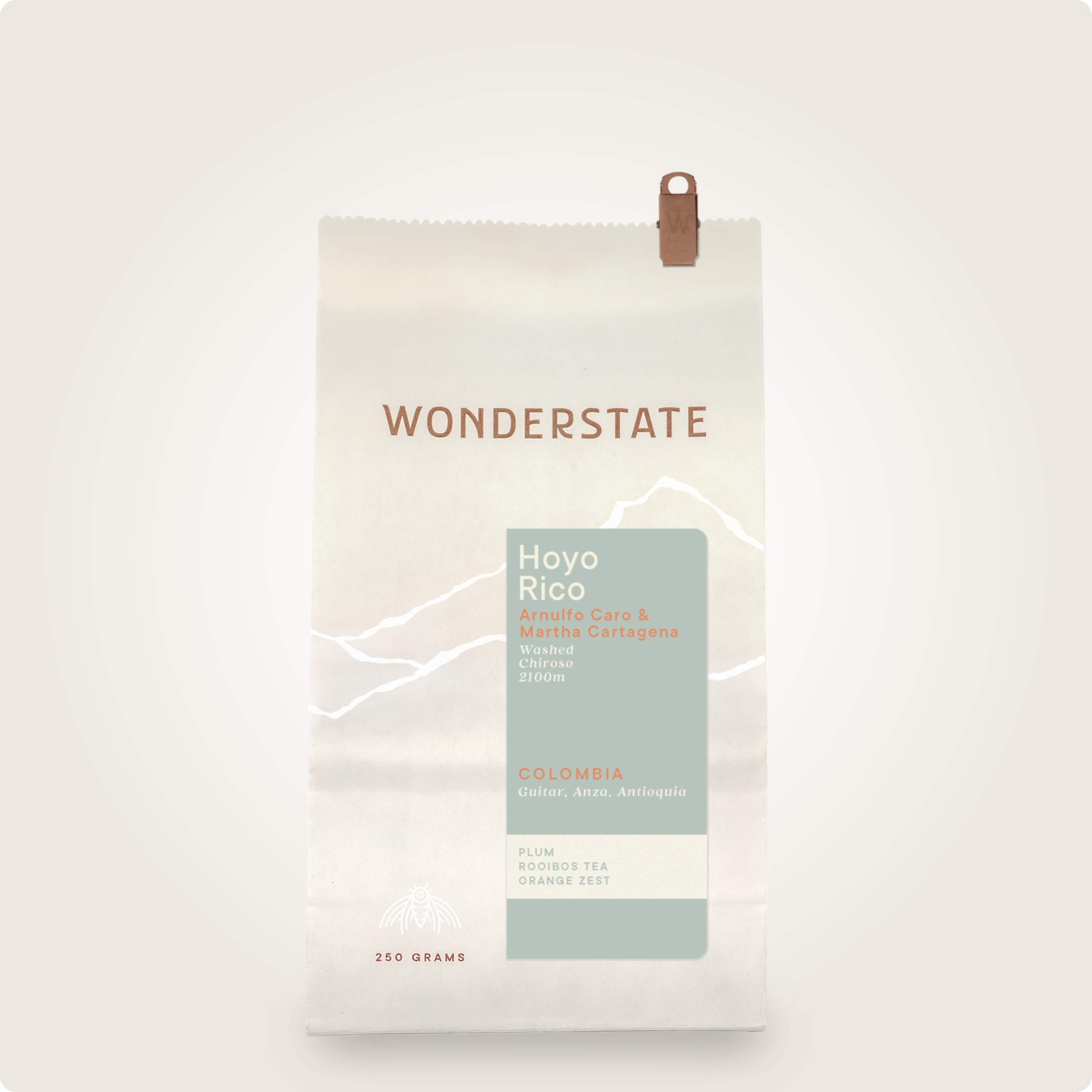
Chiroso’s origins remain a mystery, though genetic research has confirmed it is an Ethiopian landrace. Like Gesha, Sidra, and Pink Bourbon, its potential for cup quality is extraordinary. This expression of Chiroso carries the hallmark sweetness, subtle florality, and silky texture of Ethiopia’s “heirloom” coffees, while also speaking clearly of the terroir of Urrao and Anzá. The result is a cup profile far beyond what most expect from standard Colombian coffees.
This lot underwent a mixed-fermentation process: cherries rested for 3–4 days post-harvest before an 8-day wet fermentation. After washing, the coffee was dried slowly on raised beds for 2–3 weeks. Instead of producing ferment-driven or winey notes, this extended process yielded a transparent, elegant profile that highlights the distinct landscape of Anza.